Five waves. Five distinct compression mechanisms. One pattern repeating — and accelerating. By the time you finish this chapter, you have seen the evidence five times. The framework isn’t a theory. It’s a map.
Wave 1 - The Agricultural Revolution
Agriculture is the origin event. Before it, 80–90% of all human effort went to one thing: acquiring food to survive. After it, one household could feed five, which meant four households were freed from food production entirely for the first time in human history.
Over millennia, agriculture compressed the proportion of human effort needed to feed everyone, eventually freeing the majority of labor from survival entirely and leaving forager populations without a place in the new economy.
Agriculture emerged independently in several parts of the world. In the best-documented case, the compressors were the Anatolian farming communities spreading across Europe. The compressed were the hunter-gatherers, slowly outnumbered by a population that produced more children per generation. They weren’t defeated in the field. They were outnumbered in the cradle.
Surplus became possible. Surplus made specialization possible.
What got elevated: scribes, priests, artisans, merchants, soldiers, rulers, architects. Every role that defines early civilization is a downstream product of agricultural compression. Almost none of them existed at scale before surplus made them possible. World population grew from ~5–10 million at 10,000 BC to ~170–200 million by 1 AD, a 20–40x multiplier. Agricultural compression didn’t just free labor. It built civilization.
Wave 1 lasted millennia. That is the baseline. Every subsequent wave compressed faster.
The next wave compressed in eighty years.
Wave 2 - The Industrial Revolution
For centuries, a weaver made cloth by hand — years of training distilled into a specific skill that no machine could replicate. Then steam power arrived. It didn’t improve the weaver’s work. It made the weaver obsolete.
The Industrial Revolution compressed physical and mechanical labor, the embodied skill accumulated over years of apprenticeship, the cottage industries that had organized production for centuries, the craftspeople whose bodies were the primary instruments of production. The compressors were the factory owners and industrial capitalists. The compressed were the skilled artisans, weavers, and craftspeople whose expertise was being mechanized in real time — not in one workshop, but across every industry at once. Steam-powered machines could perform repetitive physical tasks faster, more consistently, and at greater scale than any human worker.
When machines begin replacing an entire way of life at once, people don’t accept it quietly. The Luddites weren’t irrational. They were skilled textile workers who broke into factories at night and destroyed the machines eliminating their livelihoods. They were right about what was happening. Parliament responded by making machine-breaking a capital crime. The British government deployed 12,000 troops to suppress the uprisings. The rules adjusted to protect the compression. They always do. With the machines protected and the resistance gone, the economics ran unchecked.
What followed was documented by Friedrich Engels and quantified by economist Robert Allen: output per worker rose 46% between 1780 and 1840. Real wages rose only 12% in the same period. The profit rate doubled. Worker income share fell from 50% to 45%.
The compressors gained while the compressed waited sixty years. That gap is called the Engels Pause, and it is not a historical curiosity. It is the template.
What got elevated: commercial clerks, accountants, engineers, teachers — the white collar class. UK commercial clerks grew from 20,000 in 1841 to 119,000 in 1871. A 6x increase in 30 years. The first mass elevated layer of cognitive work in human history. The Industrial Revolution didn’t just displace craftspeople — it created the professional class that would run the 20th century.
Wave 2 lasted eighty years, from the first factories in 1760 to the end of the Engels Pause around 1840 — millennia compressed into a lifetime. The next wave would take thirty.
Wave 3 - The Internet Revolution
The internet compressed the people who stood between you and what you needed.
A travel agent’s value was access. They had the reservation systems. You didn’t. They had the relationships with airlines and hotels. You didn’t. Their knowledge was real. It was their economic function.
The internet made that knowledge free.
The internet compressed three things simultaneously: the effort of finding information, the effort of distributing content and goods, and the effort of connecting across distance. A music record that once required a factory, a truck, and a store shelf could now reach anyone in the world as a file. Before it, each of these required physical presence, institutional intermediaries, or significant time. After it, all three collapsed toward zero marginal cost. The compressors were platform companies like Google, Amazon, eBay, and Expedia that built and owned the new infrastructure. The compressed were the intermediaries whose entire purpose was bridging information and access gaps that the internet made irrelevant.
Travel agent employment peaked at ~340,000 in 2000 and dropped ~70% by 2021. Newspaper print advertising revenue fell from $73.2 billion in 2000 to $6 billion in 2023, a 92% decline. The music industry lost $14 billion in annual revenue between 2001 and 2010. Video rental revenue collapsed 88.5% between 2002 and 2020.
The industries didn’t fail. They were made redundant.
Where did the value go? Google and Facebook alone captured 52.7% of all US online advertising revenue. Amazon captured nearly 40% of all US e-commerce sales. Platform advertising revenues more than tripled from $49.3 billion in 2013 to $160 billion in 2020, while the industries they compressed were collapsing.
This is Wave 3’s new pattern: democratize access, concentrate value. Everyone gained access to information. Almost no one gained proportional economic benefit from that access. The person searching Google gets free information. Google sells that person’s attention to advertisers for billions.
What got elevated: web developers, SEO specialists, data analysts, digital marketers, content creators, cybersecurity specialists, cloud engineers — an entirely new digital occupational layer that didn’t exist before the internet. Web developer employment alone is projected to grow 16% through 2032, adding 34,700 jobs per year. Wave 3’s elevated layer is the first to be entirely platform-dependent. That fragility matters for what comes next.
Wave 3 lasted thirty years, from the World Wide Web in 1991 to the dominance of platform monopolies by 2020. The window had shrunk to less than a generation.
The next wave didn’t compress what you could find online. It compressed the trip to the ATM, the wait for a taxi, the phone call to order food, and the GPS unit clipped to your dashboard. Everything that once required you to be somewhere specific, at a specific time.
Wave 4 - The Mobile Revolution
In 2007, the smartphone had a 3% global market share. Within nine years, global smartphone users reached 4.7 billion. Nothing in human history had ever been adopted that fast.
Before the smartphone, hailing a cab meant standing on a street corner hoping one appeared. Booking a hotel meant calling ahead. Ordering food meant calling a restaurant and hoping they delivered. Getting directions meant asking a stranger. After it, everything collapsed into a single device that is always on, always connected, and knows exactly where you are.
Wave 4 compressed the friction of coordination, navigation, transactions, and on-demand services. It did so through a physical device that eliminated entire product categories simultaneously. The smartphone didn’t compete with GPS units, cameras, and music players. It made them obsolete. Standalone GPS devices peaked in the late 2000s, then collapsed as smartphones folded navigation into a free app. Within a decade, they were relics. The compressors were Apple, Google, Uber, Airbnb, DoorDash, and the platform companies that owned the mobile infrastructure. The compressed were taxi drivers and medallion owners, camera manufacturers, GPS device makers, and the physical retail infrastructure of daily life.
The NYC taxi medallion peaked at over $1.3 million in 2013. By 2019, it was worth ~$150,000, an 88% collapse. Hundreds of medallion owners filed for bankruptcy. Multiple taxi driver suicides were linked to financial ruin. These were people who had invested life savings in a licensed, regulated asset. Uber didn’t wait for them to adapt.
What got elevated: mobile app developers, UX designers, data scientists, product managers, growth marketers, podcast hosts, content creators — and a $24 billion global influencer industry that didn’t exist before the smartphone. These were genuinely new roles the compression made possible.
Wave 4 also created something new: a labor model designed to look like elevation while functioning like compression. The drivers delivering your food, the people driving you home, the workers assembling your grocery order — all classified as independent contractors, not employees. 36% of the US workforce now participates in this kind of gig or independent work. 14% of gig workers earn below the federal minimum wage. Workers who lost traditional jobs and turned to platforms earn only 50–65% as much per hour as they previously made. Uber, Airbnb, and DoorDash became employers without any of the responsibilities that come with it.
Flexibility was the offer; insecurity is the reality.
Wave 4 lasted fifteen years, from the iPhone in 2007 to ChatGPT in 2022. The halving pattern held.
The next wave isn’t compressing what you carry in your pocket. It’s compressing what your mind produces.
Wave 5 - The Cognitive Compression
Every prior wave compressed one layer of human effort and opened a higher one. At the bottom was agriculture, which freed us from the search for food. Then the factory took the muscle, the internet took the middlemen, and the smartphone took the friction. Each wave pushed people up to the next layer, toward the same high ground: thinking. The reasoning, the writing, the analysis, the judgment — that always stayed human. It was the highest layer, and no prior wave could reach it.
Wave 5 compresses the cognitive layer directly.
The cognitive function itself is being compressed, across every industry simultaneously. A single AI system can draft legal contracts, write code, analyze financial data, generate marketing content, and produce medical summaries. The compressors are OpenAI, Anthropic, Google DeepMind, Microsoft, and every enterprise deploying AI to reduce cognitive labor costs. The compressed are lawyers, analysts, writers, coders, journalists, marketers, junior consultants, accountants, paralegals, graphic designers, translators, customer service workers — knowledge workers whose primary output is cognitive and creative.
The early numbers are already in. Entry-level job postings declined ~35% since January 2023. Employment for workers aged 22–25 in AI-exposed roles fell 6% between late 2022 and mid-2025. Young software developers saw nearly a 20% employment decline in the same period. The WEF projects 92 million jobs displaced globally by 2030, and 170 million new roles created, for a net increase of 78 million. The pattern holds — displacement is already visible, and so is the elevation.
ChatGPT launched in November 2022 and reached 100 million users in two months — the fastest a consumer technology had ever reached that scale. The smartphone had been the fastest-spreading technology of the prior wave; Wave 5 outpaced even that, before Wave 4 was fully complete. As of February 2026, ChatGPT has 900 million weekly active users. The compression didn’t wait for the world to catch up. By the time most people noticed, it was already three years in.
Wave 5 also has something no prior wave had: AI democratizes execution. The compression tool is in the hands of everyone, not just the compressors. In Wave 2, you couldn’t buy a factory. In Wave 3, you couldn’t build Google. In Wave 4, you couldn’t launch Uber. In Wave 5, you can access the same AI tools that Fortune 500 companies are using for $20 a month. A solo operator with AI fluency can now research, write, design, and ship at the speed that previously required a team.
What gets elevated: AI and machine learning specialists, prompt engineers, AI product managers, context architects, human-AI collaboration specialists — roles that didn’t exist five years ago. The WEF projects 170 million new roles created globally by 2030, the largest elevated layer in the history of the pattern, if the projection holds. What they share is not a job title. It is a way of working: cognitive processing handled by AI, strategic direction and accountability handled by humans. Wave 5 doesn’t compress job titles — it compresses the execution layer within every job title and elevates the judgment layer within the same role. The question is not “is my job safe?” It is “which layer of my job am I operating at — the execution layer or the judgment layer?”
The answer to that question is the most consequential career decision of the next eight years.
Wave 5 began in November 2022. If the pattern holds, it will compress in eight years.
Millennia. Eighty years. Thirty. Fifteen. Eight.
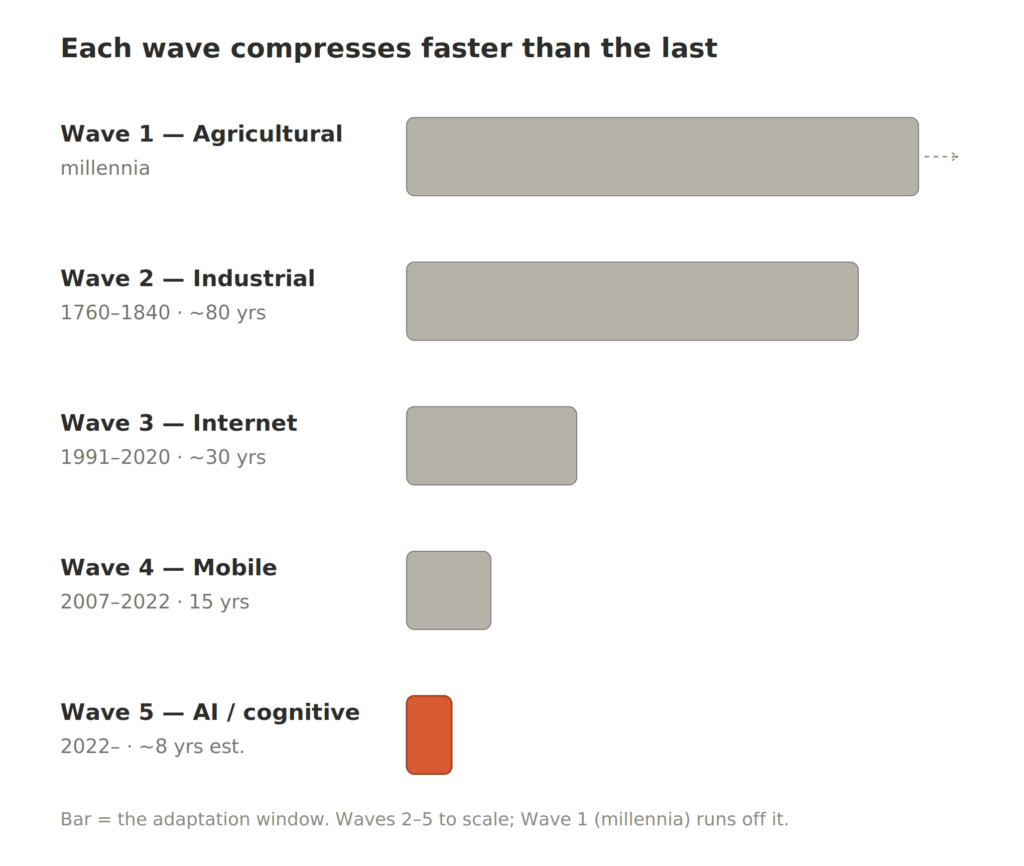
Every wave displaced one population and elevated another. Every wave followed the same logic. Every wave compressed faster than the last. The pattern has repeated five times. The evidence is in front of you.
What comes next is not more evidence. It is the question of what makes Wave 5 different from everything that came before it — and what that means for every knowledge worker alive today.
Sources & Notes
Wave 1 — The Agricultural Revolution
- Early farmers shorter, sicker, worked more than foragers: Bowles, PNAS (2011); Dyble et al., Nature Human Behaviour / University of Cambridge (2019)
- World population ~5–10M (10,000 BC) → ~170–200M (1 AD): Our World in Data
- US farm workforce 90% (1790) → under 2% today; pre-industrial 80–90% in agriculture: HumanProgress.org
- British output per labourer 2.5x, total output 2.7x, urban 17%→72%: Lumen Learning; Wikipedia — British Agricultural Revolution
Wave 2 — The Industrial Revolution
- Engels Pause — output per worker +46%, real wages +12% (1780–1840), profit rate doubled, worker income share 50%→45%: Allen, Explorations in Economic History (2009); Wikipedia — Engels’ Pause
- Machine-breaking made a capital crime; 12,000 troops deployed; Luddites 1811–1816: Wikipedia — Luddite
- UK commercial clerks 20,000 (1841) → 119,000 (1871): Norwood Library
- 16-hour days: National Geographic — Industrialization, Labor and Life
Wave 3 — The Internet Revolution
- Travel agents ~340,000 (2000), ~70% decline by 2021: TravelPerk / US BLS
- Newspaper print ad revenue $73.2B (2000) → $6B (2023), −92%; Google + Facebook 52.7% of US online ad revenue: Congressional Research Service
- Music industry −$14B (2001–2010): World Economic Forum / IFPI
- Video rental −88.5% (2002–2020); platform ad revenue $49.3B (2013) → $160B (2020): US Census Bureau
- Amazon ~40% of US e-commerce (2020): eMarketer
- Web developer employment +16% through 2032: US BLS
Wave 4 — The Mobile Revolution
- Smartphone 3% market share (2007) → 4.7B users (2016): Market.us
- NYC taxi medallion $1.3M (2013) → ~$150K (2019), −88%: Columbia Human Rights Law Review
- Standalone GPS (PND) market peaked late 2000s, then declined as smartphones absorbed navigation: ABI Research
- Gig economy 36% of US workforce: McKinsey, via TechTarget
- 14% of gig workers below federal minimum wage: Economic Policy Institute (2020)
- Gig earnings 50–65% of prior wages: Goldman Sachs, via Yahoo Finance
Wave 5 — The Cognitive Compression
- ChatGPT 100M users in two months; ~900M weekly active users (as of February 2026): Wikipedia — ChatGPT
- Entry-level postings −35% since Jan 2023 (≈100,000 fewer monthly postings): Revelio Labs, with Bloomberg (2025)
- Ages 22–25 in AI-exposed roles −6%; young software developers ~−20% (since late 2022): Stanford Digital Economy Lab — Brynjolfsson, Chandar & Chen, “Canaries in the Coal Mine?” (2025)
- SWE-Bench 4.4% (2023) → 71.7% (2024): Stanford HAI — 2025 AI Index Report
- 92M displaced / 170M created / +78M net by 2030: World Economic Forum, Future of Jobs Report 2025 (full report PDF)