Every Wave Elevates
Every compression wave has eliminated a category of human effort. Every one has also created new work.
The plough ended the world where nearly everyone spent almost every waking hour finding food. It freed a sliver of the population to do something else. That sliver became the first builders, priests, traders, and rulers — civilization is what people did with the time the plough gave back. The factory broke the craftsman and the field hand, then built the manager, the engineer, and the clerk in their place. The internet gutted the video store and the newspaper, and in the same stroke produced the web developer, the data analyst, the digital marketer — roles that had no name a generation before. The smartphone folded that entire internet into a single object in every pocket and erased the line between being online and off. The app developer and the influencer rose in the space it opened.
The pattern holds. Something gets compressed. Something else rises in its place. The people who saw the new layer early moved into it. The people who waited for the old one to come back are still waiting.
So the question for the AI wave was never whether it eliminates a category of effort, because we know that is what a compression wave does. The real question is the one the pattern always forces next: what gets elevated this time?
What the Internet Taught Us
Go back to the last wave for a moment, because it already showed us how this works.
The internet compressed information. Before it, knowing something meant having access — to a library, an archive, a directory, a professional who held the fact you needed. The internet collapsed all of it into a search box. Facts became free. The encyclopedia salesman, the travel agent, the reference desk — anyone whose living was holding information other people couldn’t reach — watched it evaporate.
But one thing didn’t compress. Knowing a fact was never the same as knowing what to do with it.
Zillow put every listing, every price, every neighborhood number in front of anyone with a phone. It did not replace the agent who can walk through a house and tell you the foundation is going to cost you forty thousand dollars to fix. The ability to apply it — in a specific situation, with something real on the line — stayed scarce. And the people who traded in that ability kept working, while the people who traded in access did not.
That distinction is the whole story of who survived the internet. It is also the key to what comes next. Because the AI wave is running the same play — one level up.
Same Job Title, Two Layers
Take a marketing role. Not the title — the actual work inside it.
Some of that work is execution. Writing the copy. Building the campaign in the platform. Scheduling the posts, pulling the performance reports, formatting the deck for Monday. For years this was most of the job, and being fast and reliable at it was how you kept it. A marketer was someone who produced marketing.
AI does all of that now. It drafts the copy in seconds, builds the variants, writes the report, formats the deck. The execution layer of the marketing job — the part that filled the day — is being absorbed in front of our eyes.
But look at what AI cannot touch. Who is this campaign actually for. What the real message is, underneath the words. Whether it’s working, and if not, why not — and what to do instead. That work doesn’t get faster with a better prompt, because it isn’t production. It’s deciding what’s worth producing in the first place.
So the marketing job isn’t disappearing. It is splitting. The execution layer fell away, and what’s left standing is the layer that decides. Two marketers can hold the same title and do almost nothing in common — one feeding the machine, the other directing it.
What happened to that marketing job is not a marketing story. It is the shape of the whole wave.
Go back to the three people from a moment ago — the graduate, the mid-career executor, the senior specialist. It looked like three different problems hitting three different stages of a career. It was one problem, hitting all of them in the same place. Every one of their jobs splits along the same seam: the execution layer, which AI absorbs, and the layer above it, which AI cannot reach. Three people. One fault line.
Same Job Title, Two Layers
Take a marketing role. Not the title — the actual work inside it.
Some of that work is execution. Writing the copy. Building the campaign in the platform. Scheduling the posts, pulling the performance reports, formatting the deck for Monday. For years this was most of the job, and being fast and reliable at it was how you kept it. A marketer was someone who produced marketing.
AI does all of that now. It drafts the copy in seconds, builds the variants, writes the report, formats the deck. The execution layer of the marketing job — the part that filled the day — is being absorbed in front of our eyes.
But look at what AI cannot touch. Who is this campaign actually for. What the real message is, underneath the words. Whether it’s working, and if not, why not — and what to do instead. That work doesn’t get faster with a better prompt, because it isn’t production. It’s deciding what’s worth producing in the first place.
So the marketing job isn’t disappearing. It is splitting. The execution layer fell away, and what’s left standing is the layer that decides. Two marketers can hold the same title and do almost nothing in common — one feeding the machine, the other directing it.
What happened to that marketing job is not a marketing story. It is the shape of the whole wave.
Take the three different profiles from Chapter 4 — the graduate, the mid-career executor, the senior specialist. It looked like three different problems hitting three different stages of a career. It was one problem, hitting all of them in the same place. Every one of their jobs splits along the same seam: the execution layer, which AI absorbs, and the layer above it, which AI cannot reach. Three people. One fault line.
The Judgment Amplification Layer
I call what survives that split the Judgment Amplification Layer. The execution gets handled by the machine. What rises in its place is the human ability to direct it — to decide what matters, to read a situation AI can’t see, to know when the output is confident but wrong. Not more cognitive work. What it elevates is the judgment that decides what the cognition is for.
And it shows up in every role, not just the headline ones. Take an operations manager, about as far from a marketer as the org chart gets. The execution layer is the schedule, the status report, the data pull, the chasing of updates that should have come in on their own. AI absorbs all of it. What it can’t do is sit in the room and know that the launch slipping two weeks matters less than the supplier who just went quiet, or decide which of three bad options the team can actually live with. One operations manager keeps the tracker updated. The other decides what the company does next. Same title. Different layer.
Marketing and operations have nothing in common except this. The work that can be specified is going to the machine. The work that requires deciding — in context, with consequences — is what’s left, and what’s rising. That is the elevated layer of the AI wave. It is not a new job. Same title, different layer.
So stop asking whether your job is safe. It’s the wrong question, and it has been the whole time.
Your job is not a single thing that either survives or doesn’t. It’s a stack of tasks, and the wave is cutting straight through the middle of it — taking the execution layer, leaving the judgment layer. The title on your email signature tells you nothing about which side of that line your day is spent on. Two people with identical titles can be on opposite sides of it right now.
So the question isn’t is my job safe. It’s sharper than that, and it’s about you specifically. Which layer are you working at?
Be honest about the answer, because most of a typical day is execution, and that’s the part the machine absorbs. If your value is that you produce the work — fast, reliable, high-volume — you are standing on the layer the wave is taking. If your value is that you decide what’s worth producing, judge whether it’s right, and own what happens next, you are standing on the layer the wave is lifting.
This is the first thing in this entire wave you actually get to decide. Everything until now has happened to people — the graduate locked out, the executor hollowed, the specialist copied. The layer you operate at is not assigned to you. It is chosen. And it can be changed.
And the market is already proving it. The World Economic Forum tracks which roles are growing fastest in the AI era. The jobs climbing aren’t the ones that produce work faster. They’re the ones that direct it, deciding what AI should do, judging whether it did it right, turning raw output into something a business can act on.
Two roles show the shape — one the market is already hiring under its own name, one I’ll name here because the work is real even where the title isn’t fixed yet.
A context architect knows a business well enough to tell AI exactly what to build: how to frame the problem, what a good answer looks like, where the model will quietly go wrong. It sounds technical. It isn’t. It’s judgment, pointed at a machine.
An AI automation specialist walks into an organization, finds the cognitive work ready to compress, and builds the system that compresses it. They don’t do the execution. They decide what can be handed to the machine, and design the handoff.
Neither role existed a decade ago. Both sit above the execution layer by definition, they exist because the execution layer is being absorbed by the machine. The work the wave is lifting is becoming the work the wave is hiring for.
The Physical Layer Boom
Here’s the part nobody saw coming.
The elevated layer isn’t only cognitive. The same wave that’s compressing knowledge work is creating one of the largest surges in demand for physical, hands-on labor in a generation — and it’s the AI buildout itself that’s driving it.
Run the logic. To compress your cognitive work, AI needs somewhere to live: data centers. Hundreds of them, each the size of a warehouse, each drawing more power than a small city. That starts with the Big Four alone (Alphabet, Amazon, Meta, Microsoft) committing roughly $725 billion in 2026 — and while much of that is chips and hardware, a huge share is physical buildout that no language model can do. It gets built by electricians pulling cable, pipefitters running cooling lines, crane operators, concrete crews, HVAC engineers, technicians fabricating the chips. The grid itself has to be rebuilt to carry the load, and a transformer doesn’t install itself.
This is the irony at the center of the wave. The companies spending billions to compress the cognitive layer cannot move a dollar of that money without the physical layer. An electrician who can wire a data center is not competing with AI. The AI is the reason the work exists. You cannot prompt a building into being, and the people who can build it are looking at a decade of demand.
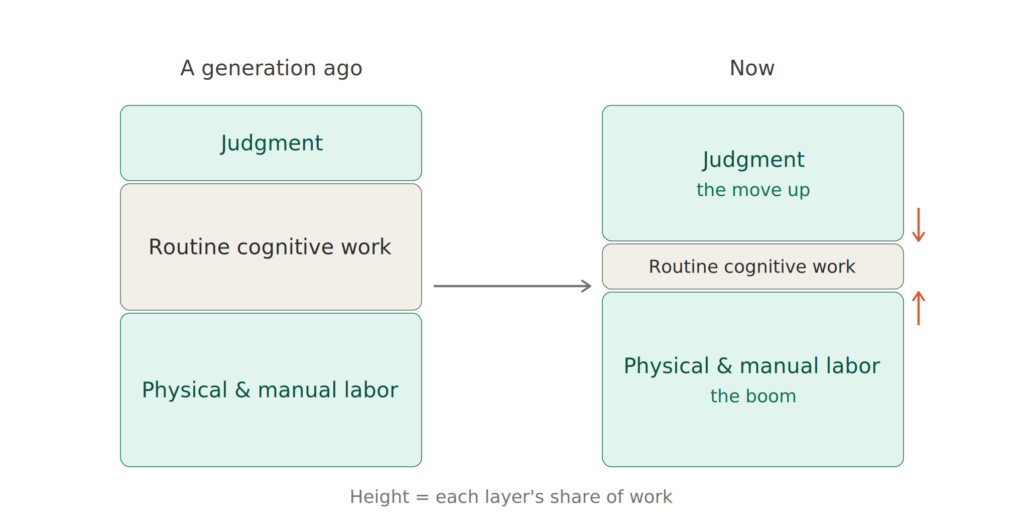
So the work that survives sits at the two ends, not the middle. At the top, the judgment layer — the work of deciding, which AI lifts into higher demand. At the base, the physical and skilled trades — the work AI can specify but cannot perform, and which the AI buildout itself is driving into a boom. What the wave compresses is the layer between them: the routine cognitive work, easy to describe and easy to automate. The middle thins. The ends carry the weight.
The Gap Is Real
Now the harder truth — the one most people writing about this leave out.
The elevated layer is real. But this time it is forming right now — alongside the compression, not after it. Every prior wave produced a new layer, without exception. What no wave has guaranteed is that the people on the old layer can reach the new one before that layer disappears.
Go back to the factory. The wave that destroyed the handloom weaver did, eventually, create the machinist, the foreman, the engineer. But “eventually” did a lot of damage. For sixty years — the Engels Pause — output and profits climbed while the people whose work had been compressed saw almost none of it. The elevated layer existed. But the man it had already put out of work just couldn’t reach it in time.
That is the risk now, and pretending otherwise would be a lie. The judgment layer is hiring. The trade layer is booming. But the wave is compressing the routine cognitive layer in the middle — the layer most people are standing on right now — faster than the new layers can absorb the people being displaced from the middle. The gap between what’s being taken and what’s being offered is real, and it is widening right now.
This is not a reason to despair. It is the opposite. The elevated layer is forming while you watch — which means the people who move toward it early move into it while there’s still room. That is the good news and the warning in the same sentence.
The Tool Is Already in Your Hands
There is one more thing about this wave that has never been true before.
In every prior wave, the elevated layer was always built on top of a tool that required capital and resources most people didn’t have. The plough required land. The steam engine required a factory. The internet and the smartphone required platforms with infrastructure and technical training that took years. The tool that did the compressing was owned by companies, and the people on the elevated layer were the ones who worked for them.
This time the tool that does the compressing is sitting on your phone. The same AI that absorbs the execution layer is available to the person being displaced by it — for the price of a streaming subscription, or nothing at all. You do not need a budget, a department, or permission to start operating at the judgment layer. You need the AI everyone already has, and the decision to use it to direct the work rather than just produce it.
That is what’s new. The elevated layer of the AI wave is not fenced off behind capital. For the first time in the history of the pattern, the people being compressed and the people who could rise are holding the exact same tool.
So here is where this leaves you.
The wave is not coming for your job. It is coming for a layer of your job — the part that can be specified, handed off, and automated. That part is leaving whether you are ready or not. What stays, what rises, and what the wave is actively hiring for, is the layer above it: the judgment to decide what’s worth doing, the context no model can see, the call that someone has to own.
The question was never whether your job is safe. It is which layer of your job you are operating at.
You can answer that question right now. Most of us spend our days in execution mode — and that is no longer where the value is. The move to the judgment layer is open to you, it costs almost nothing to begin, and you are holding the tool that makes it possible. But every wave has had a window, and every window has closed. Last time, it took six decades for the new layer to absorb the people displaced from the old one. Wave 5 is measured in years.
The window is open. The only question left is whether you move in the right direction while you still can. The move itself comes down to one thing — what you use the tool for. Chapter 6 is where you make the move.
Sources & Notes
- WEF fastest-growing roles by 2030; 170M new roles created globally by 2030: World Economic Forum, Future of Jobs Report 2025
- ~$725B data-center / infrastructure buildout: see Chapter 3, Sources & Notes
Note on one interpretive claim
The fastest-growing roles as “judgment” roles. The World Economic Forum identifies the fastest-growing roles as technology, data, and AI roles, alongside frontline roles such as delivery drivers and care workers. The reading that these roles reward directing work over producing it — and the terms “context architect” and “Judgment Amplification Layer” — are this manifesto’s framework, not WEF findings.