A Manifesto
Five times, a new technology has compressed an entire category of human effort and displaced the people whose livelihoods depended on it. Artificial Intelligence is the fifth — and the fastest. Here’s the pattern, the evidence, the window — and how to get ahead before it closes.
Some of what follows is hard to believe. All of it is documented, with sources at the end. This is evidence, not opinion.
1. Compression Pattern
Hunter-gatherers were taller, healthier, and worked fewer hours than the farmers who displaced them. Farming won anyway.
Not because farmers lived better lives. They didn’t — not at first. Farming won because it produced more people per acre. More people per acre meant more births per generation. More births per generation meant more farmers, not more hunter-gatherers — who never chose to be displaced. Farming made them structurally unnecessary — and they never had a word for what was happening.
That is the oldest version of the pattern. It has repeated four more times since.
The plough. The steam engine. The internet. The smartphone. Artificial intelligence.
Each time, a technology eliminates an entire category of human effort — and the people who depended on it lose their place in the economy. Each time, a new layer of work appears in its place — roles that didn’t exist before, skills that suddenly became scarce, capabilities that only those who moved early were positioned to capture. Each time, the gain flows to the compressors first. The compressed wait.
The compressors are those deploying the technology. The compressed are those whose labor it replaces.
The pattern has repeated five times in human history: a technology eliminates an entire category of human effort, one population loses its economic function, another rises to replace it — and the window to adapt gets shorter every time.
I call this the Human Effort Compression Cycle — and we are caught inside Wave 5, right now.
Not every technological disruption qualifies as a wave. The printing press displaced the scribes who copied books by hand — but it created far more roles than it erased, and never left an entire population without a function. The telephone compressed communication — but it created more roles than it removed.
A wave is something more specific. Something that reshapes how people live and work.
For something to qualify as a wave in the Human Effort Compression Cycle, four conditions must all be present:
One. A specific category of human effort gets compressed — not improved, not accelerated, but fundamentally eliminated at scale.
Two. A distinct population loses their economic function — not disrupted, not inconvenienced, but made unnecessary.
Three. A new elevated layer of human work emerges in its place — roles that didn’t exist before, capabilities that the compression made possible.
Four. The gain flows first to those deploying the technology — the compressors — while those whose labor it replaces — the compressed — resist, adapt, or are left behind.
All four must be present. That is what separates a wave from a disruption.
A wave doesn’t end when the next one begins. Between every wave, the same compression keeps deepening — pushing the same effort category further and faster until it reaches a limit. I call it the Acceleration Build-Up.
It is not a pause. It is not a transition. It is the compression intensifying — and it always contains the seed of what comes next.
Agriculture deepened for millennia. The plough, irrigation, crop rotation, selective breeding, and eventually railways — each one compressing food production and distribution further before industrialization ignited a genuinely new effort category: physical and mechanical labor.
The Industrial Revolution deepened through electrification, the assembly line, mass production, and computing for 150 years before the internet ignited a new one: the effort of finding information, distributing goods, and communicating across distance.
The internet deepened through broadband, e-commerce, social media, streaming, and cloud computing before the smartphone ignited another: the friction of navigating, coordinating, and transacting in the physical world.
The smartphone deepened through apps, on-demand platforms, and mobile payments — driving the digital activity and cloud infrastructure the next wave would require. Then artificial intelligence ignited the latest compression: the cognitive and creative output of knowledge workers. AI is deepening now — through multimodal models, autonomous agents, and models built for medicine, law, and finance — and it is the wave we are inside.
Each wave deepened because of the same human drive — to produce more, reach further, and compress harder until it reached a limit. And each wave ignited at the same kind of moment. Not when the technology was invented, but when it became accessible to everyone.
Steam power was being experimented with for decades before James Watt made it viable for factories. The internet existed as a military and academic network before Berners-Lee’s World Wide Web made it universally accessible. Large language models existed years before ChatGPT put them in the hands of anyone with an internet connection. The invention is never the trigger. The democratization always is.
I call it the Ignition Trigger — the moment a technology crosses the threshold from experiment to scale, from restricted to universal, from the hands of the few to the hands of everyone.
Every wave followed the same logic. A technology eliminated an effort category. A population was displaced. A new layer emerged. And the compressors gained before the compressed did — every time, without exception.
Every wave also compressed faster than the last. Millennia. Eighty years. Thirty. Fifteen. Now eight.
That number — eight — is an estimate, not a precise forecast. It is what the halving pattern produces when you extend it one wave forward. If the previous wave took fifteen years and each wave has roughly halved the window of the one before, Wave 5 gives humanity approximately eight years from start to finish. ChatGPT launched in November 2022. The window is already open. And it will not stay open.
Every wave created an adaptation window — a gap between when the compression begins and when a new layer of work takes its place. That gap is where displacement happens. It is also where the opportunity lives.
The pattern holds. What has changed is the speed — and the target. This time the compression hits cognitive labor — the thinking, writing, analysis, research, and decision-making that prior waves never touched. Every prior wave compressed physical effort and left human cognition intact. Wave 5 compresses cognition itself.
The window is open. The question is not whether it will close. Only whether you act before it does.
Every wave that compressed also elevated — a new layer of human work that didn’t exist before. Wave 5 is no different.
What follows is the evidence.
2. The Five Waves
Five waves. Five distinct compression mechanisms. One pattern repeating — and accelerating. By the time you finish this section, you have seen the evidence five times. The framework isn’t a theory. It’s a map.
Wave 1 — Agricultural Revolution
Agriculture is the origin event. Before it, 80–90% of all human effort went to one thing: acquiring food to survive. After it, one household could feed five, which meant four households were freed from food production entirely for the first time in human history.
Over millennia, agriculture compressed the proportion of human effort needed to feed everyone, eventually freeing the majority of labor from survival entirely and leaving forager populations without a place in the new economy.
Agriculture emerged independently in several parts of the world. In the best-documented case, the compressors were the Anatolian farming communities spreading across Europe. The compressed were the hunter-gatherers — slowly outnumbered by a population that produced more children per generation. They weren’t defeated in the field. They were outnumbered in the cradle.
Surplus became possible. Surplus made specialization possible.
What got elevated: scribes, priests, artisans, merchants, soldiers, rulers, architects. Every role that defines early civilization is a downstream product of agricultural compression. Almost none of them existed at scale before surplus made them possible. World population grew from ~5–10 million at 10,000 BC to ~170–200 million by 1 AD, a 20–40x multiplier. Agricultural compression didn’t just free labor. It built civilization.
Wave 1 lasted millennia. That is the baseline. Every subsequent wave compressed faster.
The next wave compressed in eighty years.
Wave 2 — Industrial Revolution
For centuries, a weaver made cloth by hand — years of training distilled into a specific skill that no machine could replicate. Then steam power arrived. It didn’t improve the weaver’s work. It made the weaver obsolete.
The Industrial Revolution compressed physical and mechanical labor, the embodied skill accumulated over years of apprenticeship, the cottage industries that had organized production for centuries, the craftspeople whose bodies were the primary instruments of production. The compressors were the factory owners and industrial capitalists. The compressed were the skilled artisans, weavers, and craftspeople whose expertise was being mechanized in real time — not in one workshop, but across every industry at once. Steam-powered machines could perform repetitive physical tasks faster, more consistently, and at greater scale than any human worker.
When machines begin replacing an entire way of life at once, people don’t accept it quietly. The Luddites weren’t irrational. They were skilled textile workers who broke into factories at night and destroyed the machines eliminating their livelihoods. They were right about what was happening. Parliament responded by making machine-breaking a capital crime. The British government deployed 12,000 troops to suppress the uprisings. The rules adjusted to protect the compression. They always do. With the machines protected and the resistance gone, the economics ran unchecked.
What followed was documented by Friedrich Engels and quantified by economist Robert Allen: output per worker rose 46% between 1780 and 1840. Real wages rose only 12% in the same period. The profit rate doubled. Worker income share fell from 50% to 45%.
The compressors gained while the compressed waited sixty years. That gap is called the Engels Pause, and it is not a historical curiosity. It is the template.
What got elevated: commercial clerks, accountants, engineers, teachers — the white collar class. UK commercial clerks grew from 20,000 in 1841 to 119,000 in 1871. A 6x increase in 30 years. The first mass elevated layer of cognitive work in human history. The Industrial Revolution didn’t just displace craftspeople — it created the professional class that would run the 20th century.
Wave 2 lasted eighty years, from the first factories in 1760 to the end of the Engels Pause around 1840 — millennia compressed into a lifetime. The next wave would take thirty.
Wave 3 — Internet Revolution
The internet didn’t compress bodies or machines. It compressed the people who stood between you and what you needed.
A travel agent’s value was access. They had the reservation systems. You didn’t. They had the relationships with airlines and hotels. You didn’t. Their knowledge was real. It was their economic function.
The internet made that knowledge free.
The internet compressed three things simultaneously: the effort of finding information, the effort of distributing content and goods, and the effort of connecting across distance. A music record that once required a factory, a truck, and a store shelf could now reach anyone in the world as a file. Before it, each of these required physical presence, institutional intermediaries, or significant time. After it, all three collapsed toward zero marginal cost. The compressors were platform companies like Google, Amazon, eBay, and Expedia that built and owned the new infrastructure. The compressed were the intermediaries whose entire purpose was bridging information and access gaps that the internet made irrelevant.
Travel agent employment peaked at ~340,000 in 2000 and dropped ~70% by 2021. Newspaper print advertising revenue fell from $73.2 billion in 2000 to $6 billion in 2023, a 92% decline. The music industry lost $14 billion in annual revenue between 2001 and 2010. Video rental revenue collapsed 88.5% between 2002 and 2020.
The industries didn’t fail. They were made redundant.
Where did the value go? Google and Facebook alone captured 52.7% of all US online advertising revenue. Amazon captured nearly 40% of all US e-commerce sales. Platform advertising revenues more than tripled from $49.3 billion in 2013 to $160 billion in 2020, while the industries they compressed were collapsing.
This is Wave 3’s new pattern: democratize access, concentrate value. Everyone gained access to information. Almost no one gained proportional economic benefit from that access. The person searching Google gets free information. Google sells that person’s attention to advertisers for billions.
What got elevated: web developers, SEO specialists, data analysts, digital marketers, content creators, cybersecurity specialists, cloud engineers — an entirely new digital occupational layer that didn’t exist before the internet. Web developer employment alone is projected to grow 16% through 2032, adding 34,700 jobs per year. Wave 3’s elevated layer is the first to be entirely platform-dependent. That fragility matters for what comes next.
Wave 3 lasted thirty years, from the World Wide Web in 1991 to the dominance of platform monopolies by 2020. The window had shrunk to less than a generation.
The next wave didn’t compress what you could find online. It compressed the trip to the ATM, the wait for a taxi, the phone call to order food, and the GPS unit clipped to your dashboard. Everything that once required you to be somewhere specific, at a specific time.
Wave 4 — Mobile Revolution
In 2007, the smartphone had a 3% global market share. Within nine years, global smartphone users reached 4.7 billion. Nothing in human history had ever been adopted that fast.
Before the smartphone, hailing a cab meant standing on a street corner hoping one appeared. Booking a hotel meant calling ahead. Ordering food meant calling a restaurant and hoping they delivered. Getting directions meant asking a stranger. After it, everything collapsed into a single device that is always on, always connected, and knows exactly where you are.
Wave 4 compressed the friction of coordination, navigation, transactions, and on-demand services. It did so through a physical device that eliminated entire product categories simultaneously. The smartphone didn’t compete with GPS units, cameras, and music players. It made them obsolete. Standalone GPS devices peaked in the late 2000s, then collapsed as smartphones folded navigation into a free app. Within a decade, they were relics. The compressors were Apple, Google, Uber, Airbnb, DoorDash, and the platform companies that owned the mobile infrastructure. The compressed were taxi drivers and medallion owners, camera manufacturers, GPS device makers, and the physical retail infrastructure of daily life.
The NYC taxi medallion peaked at over $1.3 million in 2013. By 2019, it was worth ~$150,000, an 88% collapse. Hundreds of medallion owners filed for bankruptcy. Multiple taxi driver suicides were linked to financial ruin. These were people who had invested life savings in a licensed, regulated asset. Uber didn’t wait for them to adapt.
What got elevated: mobile app developers, UX designers, data scientists, product managers, growth marketers, podcast hosts, content creators — and a $24 billion global influencer industry that didn’t exist before the smartphone. These were genuinely new roles the compression made possible.
Wave 4 also created something new: a labor model designed to look like elevation while functioning like compression. The drivers delivering your food, the people driving you home, the workers assembling your grocery order — all classified as independent contractors, not employees. 36% of the US workforce now participates in this kind of gig or independent work. 14% of gig workers earn below the federal minimum wage. Workers who lost traditional jobs and turned to platforms earn only 50–65% as much per hour as they previously made. Uber, Airbnb, and DoorDash became employers without any of the responsibilities that come with it.
Flexibility was the offer; insecurity is the reality.
Wave 4 lasted fifteen years, from the iPhone in 2007 to ChatGPT in 2022. The halving pattern held.
The next wave didn’t compress what you carried in your pocket. It compressed what you carried in your head.
Wave 5 — Cognitive Compression
Every prior wave left the cognitive layer intact. Machines replaced muscle. The internet replaced middlemen. The smartphone replaced friction. But the thinking, the reasoning, the writing, the research, the analysis, the judgment — that always remained human. It was the one layer no prior wave could reach.
Wave 5 compresses the cognitive layer directly.
The cognitive function itself is being compressed, across every industry simultaneously. A single AI system can draft legal contracts, write code, analyze financial data, generate marketing content, and produce medical summaries. The compressors are OpenAI, Anthropic, Google DeepMind, Microsoft, and every enterprise deploying AI to reduce cognitive labor costs. The compressed are lawyers, analysts, writers, coders, journalists, marketers, junior consultants, accountants, paralegals, graphic designers, translators, customer service workers — knowledge workers whose primary output is cognitive and creative.
The early numbers are already in. Entry-level job postings declined ~35% since January 2023. Employment for workers aged 22–25 in AI-exposed roles fell 6% between late 2022 and mid-2025. Young software developers saw nearly a 20% employment decline in the same period. The WEF projects 92 million jobs displaced globally by 2030, and 170 million new roles created, for a net increase of 78 million. The pattern holds — displacement is already visible, and so is the elevation.
ChatGPT launched in November 2022 and reached 100 million users in two months — the fastest a consumer technology had ever reached that scale. The smartphone had been the fastest-spreading technology of the prior wave; Wave 5 outpaced even that, before Wave 4 was fully complete. As of February 2026, ChatGPT has 900 million weekly active users. The compression didn’t wait for the world to catch up. By the time most people noticed, it was already three years in.
Wave 5 also has something no prior wave had: AI democratizes execution. The compression tool is in the hands of everyone — not just the compressors. In Wave 2, you couldn’t buy a factory. In Wave 3, you couldn’t build Google. In Wave 4, you couldn’t launch Uber. In Wave 5, you can access the same AI tools that Fortune 500 companies are using for $20 a month. A solo operator with AI fluency can now research, write, design, and ship at the speed that previously required a team.
What gets elevated: AI and machine learning specialists, prompt engineers, AI product managers, context architects, human-AI collaboration specialists — roles that didn’t exist five years ago. The WEF projects 170 million new roles created globally by 2030 — the largest elevated layer in the history of the pattern, if the projection holds. What they share is not a job title. It is a way of working: cognitive processing handled by AI, strategic direction and accountability handled by humans. Wave 5 doesn’t compress job titles — it compresses the execution layer within every job title and elevates the judgment layer within the same role. The question is not “is my job safe?” It is “which layer of my job am I operating at — the execution layer or the judgment layer?”
The answer to that question is the most consequential career decision of the next eight years.
Wave 5 began in November 2022. If the pattern holds, it will compress in eight years.
Millennia. Eighty years. Thirty. Fifteen. Eight.
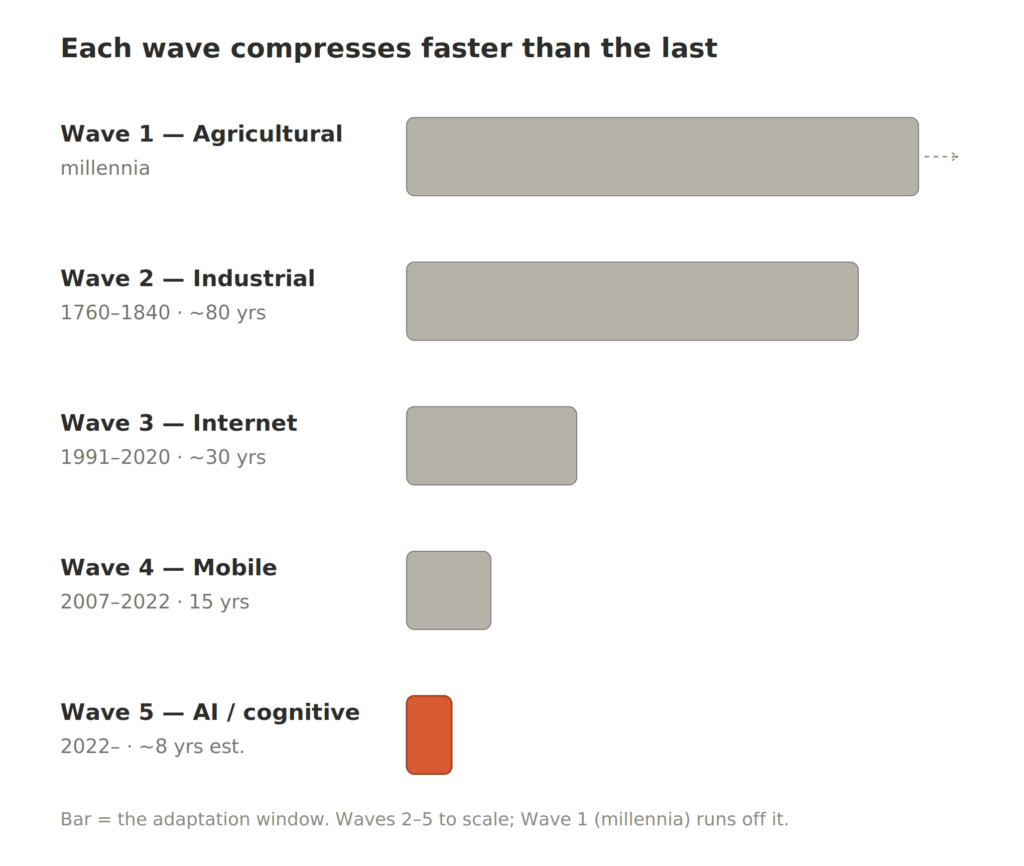
Every wave displaced one population and elevated another. Every wave followed the same logic. Every wave compressed faster than the last. The pattern has repeated five times. The evidence is in front of you.
What comes next is not more evidence. It is the question of what makes Wave 5 different from everything that came before it — and what that means for every knowledge worker alive today.
3. The AI Wave Is Different
Millennia. Eighty years. Thirty. Fifteen. Eight. Each wave compressed faster than the last. Each wave displaced one population and elevated another. Each wave followed the same pattern. But Wave 5 is happening faster, deeper, and into territory no prior wave ever reached.
The pattern hasn’t changed. The target has. Every prior wave elevated workers into the cognitive layer. Wave 5 compresses it — and the window to adapt is the shortest in history.
Every prior wave had a ceiling on what it could compress. Physical machines couldn’t replace judgment. The internet couldn’t replace creativity. The smartphone couldn’t replace expertise. Each wave compressed one layer of effort and left the cognitive layer intact — which is where it elevated people into. AI compresses that layer directly. In 2023, AI systems solved 4.4% of problems on SWE-Bench, a standardized coding benchmark. In 2024, that number was 71.7%. A 16x improvement in one year. Rapid gains are appearing across legal reasoning, medical diagnosis, and financial analysis. The adaptation strategy that worked every time before — move up the cognitive stack — is being compressed from above at the same time workers are being displaced from below.
Every prior wave compressed a specific type of labor in specific industries — textile workers, travel agents, taxi drivers, among countless others. The compressed could see where the safe ground was — whole industries the wave never reached. A single AI system can now draft legal contracts, write code, analyze financial data, generate marketing content, and produce medical summaries. The compression isn’t sector-specific. It is cognitive-function-specific. There is no adjacent knowledge industry to escape into — the routine cognitive layer is exposed everywhere at once. The safe ground isn’t in another industry. It is in a different layer of the same work — and the question of how far up that layer extends is still being answered in real time.
Wave 1 gave humanity millennia. Wave 2 gave workers roughly eighty years. Wave 3 gave industries thirty years. Wave 4 gave businesses fifteen years. Wave 5 is estimated at eight years. ChatGPT launched in November 2022. We are roughly three and a half years in — which leaves about four. If the pattern holds, the window closes around 2029 to 2030. Four years is about the length of a single undergraduate degree. Shorter than the time it takes to make partner at a firm. Shorter than the careers it is reshaping took to build.
The gains are already flowing to the compressors. Companies deploying AI are already seeing productivity gains of up to 4% — early figures expected to climb as adoption deepens. Investment in AI has nearly doubled in a single year — the Big Four tech companies alone committed $725 billion to AI infrastructure in 2026.
None of that is going to the compressed.
Entry-level job postings have declined approximately 35% since January 2023. The productivity gains are real and growing — the hiring isn’t. The compressors are gaining. The compressed are waiting.
Friedrich Engels documented this exact gap in 1845, and economist Robert Allen later quantified it — output rising, wages flat, profit doubling, workers absorbing the cost for sixty years before unions, factory acts, and political pressure finally forced the gains to flow. The gap has a name: the Engels Pause. It is not a 19th-century curiosity. It is running right now.
In every prior wave, the tool doing the displacing belonged to someone else. Industrialists owned the mills. Corporations owned the infrastructure. Platform companies owned the apps. The displaced — handloom weavers, travel agents, taxi drivers — had no access to the tool doing the displacing. The power loom wasn’t theirs. The platform wasn’t theirs. The app wasn’t theirs.
For the first time in the history of the cycle, that has changed. The AI capability being deployed to reduce headcount is the same capability accessible to any individual today — for twenty dollars a month. The displacement is real. But no prior wave handed the compression tool to the population it was compressing. The same tool. Opposite hands. It is the hardest compression in history. And the first one where the displaced have access to what is displacing them.
Wave 4 built a new labor model. They called it flexibility. Uber needed drivers without the obligations that come with employing them — no benefits, no minimum wage protection, no severance. Workers who left traditional employment for gig platforms earned 50 to 65% of what they previously made per hour. The drivers delivered the value. The platform captured it.
AI companies are applying the same model one layer up the stack. The writers, coders, and creators whose work trained the models were not compensated for it. The knowledge workers whose expertise built that training data are now competing against the systems it produced. The displaced worker’s output is the training data for the system replacing them. Labor without compensation. Output without ownership. Gains to the platform. The template is identical — only the labor category has changed.
In Wave 2, when workers resisted, Parliament made machine-breaking a capital crime. The rules adjusted to protect the compressors. They always do. In Wave 5, no rules yet protect the compressed from displacement. That gap is not neutrality. It is a structural advantage for the compressor. The window isn’t only closing because the technology is moving fast. It is closing because nothing is slowing it down.
Five waves. Five compressions. The same pattern, every time. The only question that has ever mattered — in every wave, for every displaced population — is not whether the compression is coming. It is whether you are positioned above it when it arrives.
In Wave 5, the time you have to reposition is measured in years, not generations.
4. Who's Most at Risk in Wave 5
Not everyone inside Wave 5 is at the same risk. The compression reaches every industry — but the exposure is not equal. Three populations are carrying most of it.
The Graduate
Entry-level roles have always done two things: they paid a wage and they taught a craft. You got paid to do the work, and in doing the work, you built the expertise that would carry you forward. The execution layer was the on-ramp. Junior analyst, junior developer, junior associate — these roles existed because organizations needed the work done and individuals needed a way in.
Wave 5 is dismantling both functions at once. Entry-level job postings have declined approximately 35% since January 2023. The income opportunity is shrinking. But the deeper loss is the apprenticeship function — the structured exposure to real work, under senior supervision, that turns a graduate into a professional. AI is doing the drafting, the research, the analysis, the coding. The work that entry-level roles were built around is being automated. The work that built careers is disappearing alongside the jobs.
If you are entering the workforce now, you are facing something no prior generation faced. The traditional path from junior to senior — a decade of doing execution work under supervision — is being compressed or eliminated. The on-ramp to expertise is being pulled up before you reach it. If this is you, the path your predecessors walked — junior role, years of supervised reps, slow climb to expertise — is closing while you stand at the bottom of it. Your move is to build judgment directly, without waiting for a job to hand it to you.
The Mid-Career Executor
Five to fifteen years in, and the career is built on a specific thing: being exceptionally good at the work. Analysis. Writing. Legal drafting. Financial modeling. Code. The skill is real. The track record is real. The reputation, built over years of producing output that organizations relied on, is real.
The problem is that Wave 5 doesn’t compress job titles. It compresses the layer of the job where most of the work happens — and for the mid-career executor, that layer is where most of their identity lives. The compression isn’t coming for the title. It is coming for the hours. The drafting, the research, the modeling, the reporting — the work that fills the day, demonstrates the expertise, and justifies the salary. AI is absorbing it.
The mid-career executor has enough experience to have built a strong identity around their execution skills, and not yet enough seniority to have naturally moved above them. They are caught precisely where the compression is deepest. The title stays the same. The work that earned it is being hollowed out from the inside. If this is you, the skill that built your career is the exact thing the wave is absorbing — and the move is to stop competing on execution speed and start competing on the judgment that decides what the execution is for.
The Senior Specialist
Thirty years building expertise in a domain. Law. Medicine. Finance. Consulting. The knowledge is real — earned through decades of cases, deals, diagnoses, and decisions that no junior professional and no textbook could replicate. That knowledge was the product. Clients paid for it. Organizations were built around it.
AI is not replacing that knowledge. It is codifying it. Every contract a senior lawyer has reviewed, every case a senior physician has diagnosed, every financial model a senior analyst has built — work of exactly this kind now sits in the training data at scale, ingested from millions of documents like the ones they spent careers producing. The knowledge is intact. The scarcity is gone.
The compressor is gaining. The compressed is waiting.
And it is not only happening at the level of publicly available knowledge. The law firm deploying AI trained on decades of its own case files is codifying the senior partner’s expertise inside the firm’s own systems. The hospital using AI fine-tuned on its patient records is doing the same. The bank, the consultancy, the research firm — all of them. The organization that once relied on the senior specialist’s knowledge is now systematically encoding it. In many cases, without telling them.
A senior specialist competing in a market where AI has ingested the outputs of millions of professionals like them is not competing on expertise anymore. They are competing on something else — judgment, relationships, accountability, the irreplaceable capacity to be wrong and bear the consequences. AI produces outputs without consequences. The senior specialist doesn’t. If this is you, your edge was never only the knowledge — it was the judgment, the relationships, and the willingness to put your name on a call and answer for it. That is the part AI can’t take, and the move is to lead with it now, before the market decides expertise alone is something it can buy by the token.
Three different profiles. Three different stages of a career. One window — and it is closing on all three.
5. What Gets Elevated
Every compression wave has destroyed work. Every one has also created it.
The plough ended the world where nearly everyone spent almost every waking hour finding food. It freed a sliver of the population to do something else. That sliver became the first builders, priests, traders, and rulers — civilization is what people did with the time the plough gave back. The factory broke the craftsman and the field hand, then built the manager, the engineer, and the clerk in their place. The internet gutted the video store and the newspaper, and in the same stroke produced the web developer, the data analyst, the digital marketer — roles that had no name a generation before. The smartphone folded that entire internet into a single object in every pocket and erased the line between being online and off. The app developer and the influencer rose in the space it opened.
The pattern holds. Something gets compressed. Something else rises in its place. The people who saw the new layer early moved into it. The people who waited for the old one to come back are still waiting.
So the question for the AI wave was never whether it destroys work. We know it does. That is what a compression wave is. The real question is the one the pattern always forces next: what gets elevated this time?
Go back to the last wave for a moment, because it already showed us how this works.
The internet compressed information. Before it, knowing something meant having access — to a library, an archive, a directory, a professional who held the fact you needed. The internet collapsed all of it into a search box. Facts became free. The encyclopedia salesman, the travel agent, the reference desk — anyone whose living was holding information other people couldn’t reach — watched it evaporate.
But one thing didn’t compress. Knowing a fact was never the same as knowing what to do with it.
Zillow put every listing, every price, every neighborhood number in front of anyone with a phone. It did not replace the agent who can walk through a house and tell you the foundation is going to cost you forty thousand dollars to fix. The ability to apply it — in a specific situation, with something real on the line — stayed scarce. And the people who traded in that ability kept working, while the people who traded in access did not.
That distinction is the whole story of who survived the internet. It is also the key to what comes next. Because the AI wave is running the same play — one level up.
Take a marketing role. Not the title — the actual work inside it.
Some of that work is execution. Writing the copy. Building the campaign in the platform. Scheduling the posts, pulling the performance reports, formatting the deck for Monday. For years this was most of the job, and being fast and reliable at it was how you kept it. A marketer was someone who produced marketing.
AI does all of that now. It drafts the copy in seconds, builds the variants, writes the report, formats the deck. The execution layer of the marketing job — the part that filled the day — is being absorbed in front of our eyes.
But look at what AI cannot touch. Who is this campaign actually for. What the real message is, underneath the words. Whether it’s working, and if not, why not — and what to do instead. That work doesn’t get faster with a better prompt, because it isn’t production. It’s deciding what’s worth producing in the first place.
So the marketing job isn’t disappearing. It is splitting. The execution layer fell away, and what’s left standing is the layer that decides. Two marketers can hold the same title and do almost nothing in common — one feeding the machine, the other directing it.
What happened to that marketing job is not a marketing story. It is the shape of the whole wave.
Go back to the three people from a moment ago — the graduate, the mid-career executor, the senior specialist. It looked like three different problems hitting three different stages of a career. It was one problem, hitting all of them in the same place. Every one of their jobs splits along the same seam: the execution layer, which AI absorbs, and the layer above it, which AI cannot reach. Three people. One fault line.
I call what survives that split the Judgment Amplification Layer. The execution gets handled by the machine. What rises in its place is the human ability to direct it — to decide what matters, to read a situation AI can’t see, to know when the output is confident but wrong. Not more cognitive work. What it elevates is the judgment that decides what the cognition is for.
And it shows up in every role, not just the headline ones. Take an operations manager — about as far from a marketer as the org chart gets. The execution layer is the schedule, the status report, the data pull, the chasing of updates that should have come in on their own. AI absorbs all of it. What it can’t do is sit in the room and know that the launch slipping two weeks matters less than the supplier who just went quiet, or decide which of three bad options the team can actually live with. One operations manager keeps the tracker updated. The other decides what the company does next. Same title. Different layer.
Marketing and operations have nothing in common except this. The work that can be specified is going to the machine. The work that requires deciding — in context, with consequences — is what’s left, and what’s rising. That is the elevated layer of the AI wave. It is not a new job. Same title, different layer.
So stop asking whether your job is safe. It’s the wrong question, and it has been the whole time.
Your job is not a single thing that either survives or doesn’t. It’s a stack of tasks, and the wave is cutting straight through the middle of it — taking the execution layer, leaving the judgment layer. The title on your email signature tells you nothing about which side of that line your day is spent on. Two people with identical titles can be on opposite sides of it right now.
So the question isn’t is my job safe. It’s sharper than that, and it’s about you specifically. Which layer are you working at?
Be honest about the answer, because most of a typical day is execution, and that’s the part the machine absorbs. If your value is that you produce the work — fast, reliable, high-volume — you are standing on the layer the wave is taking. If your value is that you decide what’s worth producing, judge whether it’s right, and own what happens next, you are standing on the layer the wave is lifting.
This is the first thing in this entire wave you actually get to decide. Everything until now has happened to people — the graduate locked out, the executor hollowed, the specialist copied. The layer you operate at is not assigned to you. It is chosen. And it can be changed.
And the market is already proving it. The World Economic Forum tracks which roles are growing fastest in the AI era. The jobs climbing aren’t the ones that produce work faster. They’re the ones that direct it — deciding what AI should do, judging whether it did it right, turning raw output into something a business can act on.
Two roles show the shape — one the market is already hiring under its own name, one I’ll name here because the work is real even where the title isn’t fixed yet.
A context architect knows a business well enough to tell AI exactly what to build: how to frame the problem, what a good answer looks like, where the model will quietly go wrong. It sounds technical. It isn’t. It’s judgment, pointed at a machine.
An AI automation specialist walks into an organization, finds the cognitive work ready to compress, and builds the system that compresses it. They don’t do the execution. They decide what can be handed to the machine, and design the handoff.
Neither role existed a decade ago. Both sit above the execution layer by definition — they exist because the execution layer is being absorbed by the machine. The work the wave is lifting is becoming the work the wave is hiring for.
Here’s the part nobody saw coming.
The elevated layer isn’t only cognitive. The same wave that’s compressing knowledge work is creating one of the largest surges in demand for physical, hands-on labor in a generation — and it’s the AI buildout itself that’s driving it.
Run the logic. To compress your cognitive work, AI needs somewhere to live: data centers. Hundreds of them, each the size of a warehouse, each drawing more power than a small city. That starts with the Big Four alone (Alphabet, Amazon, Meta, Microsoft) committing roughly $725 billion in 2026 — and while much of that is chips and hardware, a huge share is physical buildout that no language model can do. It gets built by electricians pulling cable, pipefitters running cooling lines, crane operators, concrete crews, HVAC engineers, technicians fabricating the chips. The grid itself has to be rebuilt to carry the load, and a transformer doesn’t install itself.
This is the irony at the center of the wave. The companies spending billions to compress the cognitive layer cannot move a dollar of that money without the physical layer. An electrician who can wire a data center is not competing with AI. The AI is the reason the work exists. You cannot prompt a building into being, and the people who can build it are looking at a decade of demand.
So the work that survives sits at the two ends, not the middle. At the top, the judgment layer — the work of deciding, which AI lifts into higher demand. At the base, the physical and skilled trades — the work AI can specify but cannot perform, and which the AI buildout itself is driving into a boom. What the wave compresses is the layer between them: the routine cognitive work, easy to describe and easy to automate. The middle thins. The ends carry the weight.
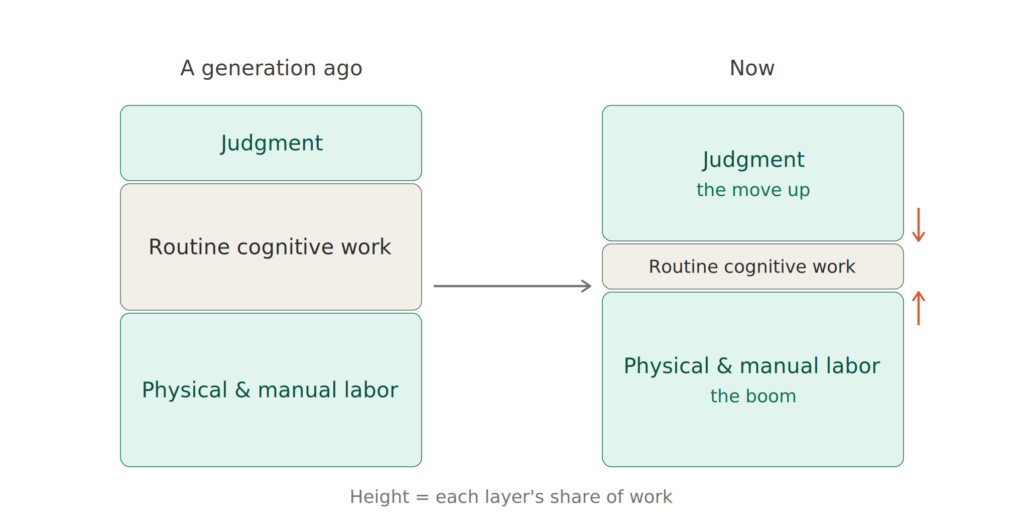
Now the harder truth — the one most people writing about this leave out.
The elevated layer is real. But this time it is forming right now — alongside the compression, not after it. Every prior wave produced a new layer, without exception. What no wave has guaranteed is that the people on the old layer can reach the new one before that layer disappears.
Go back to the factory. The wave that destroyed the handloom weaver did, eventually, create the machinist, the foreman, the engineer. But “eventually” did a lot of damage. For sixty years — the Engels Pause — output and profits climbed while the people whose work had been compressed saw almost none of it. The elevated layer existed. But the man it had already put out of work just couldn’t reach it in time.
That is the risk now, and pretending otherwise would be a lie. The judgment layer is hiring. The trade layer is booming. But the wave is compressing the routine cognitive layer in the middle — the layer most people are standing on right now — faster than the new layers can absorb the people being displaced from the middle. The gap between what’s being taken and what’s being offered is real, and it is widening right now.
This is not a reason to despair. It is the opposite. The elevated layer is forming while you watch — which means the people who move toward it early move into it while there’s still room. That is the good news and the warning in the same sentence.
There is one more thing about this wave that has never been true before.
In every prior wave, the elevated layer was always built on top of a tool that required capital and resources most people didn’t have. The plough required land. The steam engine required a factory. The internet and the smartphone required platforms with infrastructure and technical training that took years. The tool that did the compressing was owned by companies, and the people on the elevated layer were the ones who worked for them.
This time the tool that does the compressing is sitting on your phone. The same AI that absorbs the execution layer is available to the person being displaced by it — for the price of a streaming subscription, or nothing at all. You do not need a budget, a department, or permission to start operating at the judgment layer. You need the AI everyone already has, and the decision to use it to direct the work rather than just produce it.
That is what’s new. The elevated layer of the AI wave is not fenced off behind capital. For the first time in the history of the pattern, the people being compressed and the people who could rise are holding the exact same tool.
So here is where this leaves you.
The wave is not coming for your job. It is coming for a layer of your job — the part that can be specified, handed off, and automated. That part is leaving whether you are ready or not. What stays, what rises, and what the wave is actively hiring for, is the layer above it: the judgment to decide what’s worth doing, the context no model can see, the call that someone has to own.
The question was never whether your job is safe. It is which layer of your job you are operating at.
You can answer that question right now. Most of us spend our days in execution mode — and that is no longer where the value is. The move to the judgment layer is open to you, it costs almost nothing to begin, and you are holding the tool that makes it possible. But every wave has had a window, and every window has closed. Last time, it took six decades for the new layer to absorb the people displaced from the old one. Wave 5 is measured in years.
The window is open. The only question left is whether you move in the right direction while you still can.
6. The Call
So the window is open — and you know the move is up, out of the execution layer and into the judgment layer.
This is the part where we answer the only question left. How.
You make the move by changing one thing — what you use the tool for. That’s the whole call. What follows is how it looks in practice — close enough to your own day that you’ll see yourself in it.
Watch how two people use AI differently.
The first one uses it to go faster. The reports that took an hour take ten minutes. The emails write themselves, the deck builds in a single prompt. They are thrilled — faster feels like progress, even when progress lands you on the same layer. They have made their execution layer efficient. They have also made themselves easier to replace — because what they’re now fast at is exactly what the machine already does, at a fraction of the cost.
The second one uses it to decide. They hand the machine the production — the drafting, the formatting, the first pass — and spend the time it gives back on the part of the job that used to get crowded out by the production itself: what is this actually for, what’s the real problem here, which of these three options do we live with. They are not producing faster. They are deciding better, and more often.
Same tool, opposite outcomes. The difference isn’t skill — it’s what you use it for: producing, or deciding.
Don’t use AI like a calculator. A calculator makes you faster at the math you were already doing — it never decides which math is worth doing. Use AI that way and you stay exactly where you are, just quicker. Use it to decide what’s worth doing instead, and you’ve moved up a layer.
Here is the part where the clock starts.
The judgment layer is not infinite. Every wave hands its gains to the early movers first — the factory owners who mechanized before the market saturated, the developers who built apps when the App Store was still new, the people who figured out the web while it was still strange. By the time the rest arrived, the room was full and the advantage was gone.
So surviving the AI wave and getting ahead of it are two different things. Surviving means you hold on where you are. Getting ahead means you move up while there’s still room on the layer above — before everyone who waited arrives at once.
Adapt early enough to get ahead, not just survive.
Here is the second half of the call — the part most people skip.
This was never only your problem to solve.
Go back to the pattern one last time. In every wave, the gap between what got compressed and what got elevated was real, and it hurt real people — and it never closed on its own. The market did not reach back and lift the handloom weaver into the machinist’s job. For sixty years during the Engels Pause, output and profit climbed while the people whose work had been compressed waited for a benefit that the market, left alone, was in no hurry to deliver. The gap closed when people and institutions acted — not because the market corrected itself.
That’s not ideology. It’s the pattern, documented across every wave. And it means the honest version of this call has two halves — because the individual can move, but the individual did not create the gap, and cannot be the only one held responsible for it.
So this part is for the companies.
If you are deploying AI to compress the cognitive work of your people — and you are, or you will be — you are standing exactly where the factory owner stood. You are capturing the gain first. That is how the pattern works, and there’s no shame in it.
But you have a choice the factory owner didn’t know he had. He had no pattern to read — he was just doing the math: automate, save money, repeat. You’ve seen the pattern. He hadn’t. So for you it’s a decision; for him it was a reflex. You can take the savings and bank them, shed the people whose execution layer you just automated, and let the gap be someone else’s problem. Or you can use some of what AI frees to move your people up the stack — to put them on the judgment layer your business is about to need more of, not less. The second path is slower, and it shows up as a cost before it shows up as a gain — the gain being a workforce that points AI at the right problems instead of being outpaced by it, and the knowledge of your business staying inside it. It is also the only one that doesn’t leave your people stranded in the gap, the way every wave before it did.
That’s a responsibility, not a suggestion. The gap is real, and it won’t close on its own. Someone has to close it — individuals moving, companies helping, and, as every wave before showed, institutions stepping in. And the ones best placed to act first are the ones capturing the gain.
If they don’t, history already showed how long that wait can run. Last time, it ran sixty years — but we don’t yet know the human cost of this gap, only that the path to adaptation isn’t built, and the technology won’t wait for us to figure it out. In past waves you could lose a job and find similar work elsewhere; this time the same work is thinning out in many places at once, so that exit is closing. Moving up is the safer path, not just the better one.
Back to you. You can’t wait for companies and institutions to sort this out — and you don’t have to.
The move up sounds abstract until you take the first step. So here it is — and it costs you nothing but twenty minutes. Take your own job and split it down the middle. On paper, by hand — the writing is the move. On one side, write the work that could be specified — handed off with instructions clear enough to get it done, to a person or to AI: the reports, the first drafts, the formatting, the routine analysis, the updates you chase. On the other side, write the work that needs you in the room: the calls, the trade-offs, the reading of a situation no instruction could capture. Be honest about how big each side is.
Writing forces thinking. Thinking forces reflection, and reflection brings the shape of your job into view — the two layers, the size of each, the work that’s been hiding inside the work. Until you see both layers, every action is a guess.
That’s it. That’s the first move. We call it the Layer Split, and most people have never done it once — they’ve never looked at their own job as two layers instead of one. The moment you do, the rest stops being abstract. You can see your execution layer and what’s safe to hand the machine. And you can see, in your own handwriting, exactly where you need to spend the time it gives back.
This is where the Human Effort Compression Cycle stops happening to you and becomes yours to act on. The Layer Split is the front door. What comes after it — how you move into the judgment layer for your role, which looks different for an operations manager than for a marketer than for a graduate — is the methodology NFH is building, role by role. The role guides live here: Layer Split by Role. The first step costs nothing.
So here is the whole thing, in the only terms that matter — yours.
For the fifth time, a wave is compressing human effort. It is taking the execution layer of your work, the part that can be specified and handed off. It is lifting a judgment layer in its place — the deciding, the context, the judgment someone has to own. There is a window between the taking and the lifting, and it is measured in years, not generations. You are inside it right now.
The question was never whether your job is safe. It is which layer of your job you are operating at — and whether you move up while you still can.
Now you know how to start — you have the tool in your hand already, the same one doing the compressing. The first move costs nothing and you can make it today. Every wave before this one forced the same choice: move up, or get left behind. This is the first time in that long history that the people being compressed are holding the very tool that lets them rise.
The window is open. The only question left is whether you walk through it.
About
Carlos Ayala is the founder of Nexus Forge Hub (NFH). NFH builds the methodology that helps individuals, solopreneurs, and companies move from the execution layer to the judgment layer, role by role. The manifesto makes the case for the move; the methodology shows you how.
Companion Materials
- The Elevated Roles — roles Wave 5 is lifting into demand.
- Layer Split by Role — the Layer Split applied to specific roles.
- FAQ — common questions about the framework, answered.
- Glossary — definitions of HECC terms and framework concepts.
Sources & Notes
Every figure in this manifesto is drawn from a named institutional, academic, or industry source. They are grouped below by section. Two figures are time-stamped because they change: where you see a date, read the number as a snapshot, not a constant.
Two claims in this manifesto are interpretation built on the data, not the data itself — flagged as Notes below so you can weigh them yourself.
2. The Five Waves
Wave 1 — Agricultural Revolution
- Early farmers shorter, sicker, worked more than foragers: Bowles, PNAS (2011); Dyble et al., Nature Human Behaviour / University of Cambridge (2019)
- World population ~5–10M (10,000 BC) → ~170–200M (1 AD): Our World in Data
- US farm workforce 90% (1790) → under 2% today; pre-industrial 80–90% in agriculture: HumanProgress.org
- British output per labourer 2.5x, total output 2.7x, urban 17%→72%: Lumen Learning; Wikipedia — British Agricultural Revolution
Wave 2 — Industrial Revolution
- Engels Pause — output per worker +46%, real wages +12% (1780–1840), profit rate doubled, worker income share 50%→45%: Allen, Explorations in Economic History (2009); Wikipedia — Engels’ Pause
- Machine-breaking made a capital crime; 12,000 troops deployed; Luddites 1811–1816: Wikipedia — Luddite
- UK commercial clerks 20,000 (1841) → 119,000 (1871): Norwood Library
- 16-hour days: National Geographic — Industrialization, Labor and Life
Wave 3 — Internet Revolution
- Travel agents ~340,000 (2000), ~70% decline by 2021: TravelPerk / US BLS
- Newspaper print ad revenue $73.2B (2000) → $6B (2023), −92%; Google + Facebook 52.7% of US online ad revenue: Congressional Research Service
- Music industry −$14B (2001–2010): World Economic Forum / IFPI
- Video rental −88.5% (2002–2020); platform ad revenue $49.3B (2013) → $160B (2020): US Census Bureau
- Amazon ~40% of US e-commerce (2020): eMarketer
- Web developer employment +16% through 2032: US BLS
Wave 4 — Mobile Revolution
- Smartphone 3% market share (2007) → 4.7B users (2016): Market.us
- NYC taxi medallion $1.3M (2013) → ~$150K (2019), −88%: Columbia Human Rights Law Review
- Standalone GPS (PND) market peaked late 2000s, then declined as smartphones absorbed navigation: ABI Research
- Gig economy 36% of US workforce: McKinsey, via TechTarget
- 14% of gig workers below federal minimum wage: Economic Policy Institute (2020)
- Gig earnings 50–65% of prior wages: Goldman Sachs, via Yahoo Finance
Wave 5 — Cognitive Compression
- ChatGPT 100M users in two months (fastest consumer adoption at the time); ~900M weekly active users (as of February 2026): Wikipedia — ChatGPT
- Entry-level postings −35% since Jan 2023 (≈100,000 fewer monthly postings): Revelio Labs, with Bloomberg (2025)
- Ages 22–25 in AI-exposed roles −6%; young software developers ~−20% (since late 2022): Stanford Digital Economy Lab — Brynjolfsson, Chandar & Chen, “Canaries in the Coal Mine?” (2025)
- SWE-Bench 4.4% (2023) → 71.7% (2024): Stanford HAI — 2025 AI Index Report
- 92M displaced / 170M created / +78M net by 2030: World Economic Forum, Future of Jobs Report 2025 (full report PDF)
3. The AI Wave Is Different
- SWE-Bench 16x improvement (2023→2024): see Wave 5
- Productivity up to ~4% across 12,000+ European firms: Bank for International Settlements (2024), analysis
- Big Four (Alphabet, Amazon, Meta, Microsoft) committed ~$725B in 2026 capital expenditure, the bulk of it AI infrastructure — ~77% above 2025’s $410B; compiled from Q1 2026 earnings reports: Statista (Apr 2026); Financial Times compilation, via Tom’s Hardware
- Engels Pause (1845 documentation): see Wave 2
4. Who Is Most at Risk in Wave 5
- Entry-level postings −35% since Jan 2023: see Wave 5
- Codification of expertise into training data: synthesis of the Wave 5 mechanism (no single figure)
5. What Gets Elevated
- WEF fastest-growing roles by 2030; 170M new roles by 2030: World Economic Forum, Future of Jobs Report 2025
- ~$725B data-center / infrastructure buildout: see Section 3
A Note on Two Interpretive Claims
- The fastest-growing roles as “judgment” roles (Section 5). The World Economic Forum identifies the fastest-growing roles as technology, data, and AI roles, alongside frontline roles such as delivery drivers and care workers. The reading that these roles reward directing work over producing it — and the terms “context architect” and “the Audit Move” — are this manifesto’s framework, not WEF findings.
- The $725B as “AI infrastructure” (Sections 3 and 5). The $725B is the four companies’ total 2026 capital expenditure; the overwhelming majority, but not all, is AI-related.
Full per-wave sourcing, including every figure not listed above, lives in the research records behind this manifesto.